How I got to Miami
A piano I walked away from, a public library full of vinyl, and a letter in the post box that settled what I wanted to do.
I gave the piano one year in second grade and walked away. I liked music. I just wanted to play soccer.
Fourth grade changed that. I decided I wanted to play the saxophone. Part of it was seeing saxophones in the media and hearing rock and pop songs. What actually did it was the public library.
I grew up in the West End of Richmond, Virginia, and the library in Henrico County had a vinyl collection that was massive. An entire section of the building. Every week or two I went in, went through the albums looking for anything with a saxophone on the cover, checked it out and listened. Charlie Parker. Cannonball Adderley. The Dave Brubeck Quartet with Paul Desmond. Then, pretty early on, John Coltrane. Coltrane was the one. One of the first tracks I heard, before I knew anything about the virtuoso playing in it, was Giant Steps. That was one of the songs that made me want to play.
By then I was on alto, just starting out, and hell bent on becoming a jazz musician. I loved improvising. I loved the technicality too, the study and the intense focus it takes to play at that level. I practised on my own every day and wanted to get better every time. I wanted guidance, so I went looking for lessons from talented people. Ellis Marsalis ran the jazz programme at Virginia Commonwealth University at the time, and there was an amazing saxophonist there called Al Waters. I studied with him for a little less than a year, until he went on the road playing tenor sax with Ray Charles. When they came through Richmond, I got to watch him play live.
With him gone, I started digging into music schools and universities in the US. VCU was not a big jazz school. I had heard of Berklee, the famous one in Boston, not the one in California, and I fixed on it.
First there was a problem to solve. My private school had no music programme at all. Only a handful of us cared about music. I had met a lot of people from the local middle school and realised it had a massive music programme. So I took myself out of the private school. I had an exit interview with the principal, who wanted to know why I was leaving in seventh grade, a random time to move. I told him about my passion for music and that the programme did not support it. He accepted that.
In eighth grade I played in multiple bands, added tenor saxophone to the alto and joined the jazz programme. I marched in a band that supported the Virginia Batonettes, touring a different town in Virginia every weekend. Great fun. I have always loved live performance, although I hated marching band in high school. That is a different story.
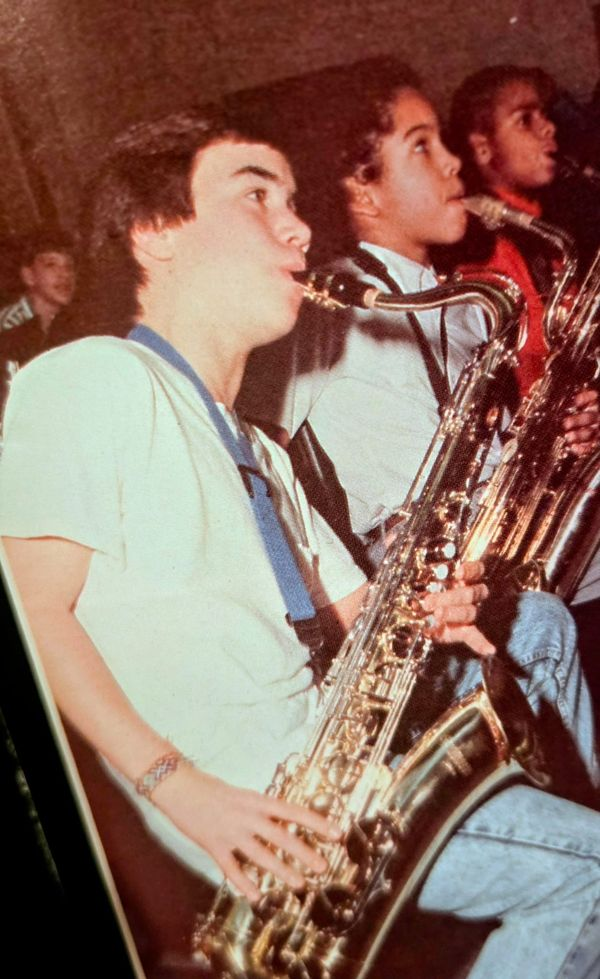
I had auditioned for the high school jazz band while still in eighth grade, which was unheard of, and I went straight into it as a freshman. I was the only first-year student in the premier band. After that year I auditioned for the all-state jazz band and got in. A traditional jazz band has a bari sax, two tenors and two altos. I made second alto as a sophomore.
The all-state band was an amazing experience. I met a lot of talented musicians and had an amazing performance. It also put me on the mailing lists of music schools, and back then that meant physical mail. Envelopes arrived from Berklee and from schools all over the United States.
By junior year I was playing in rock bands and building my own speakers. The technology of sound and music was taking over from the instrument. I was also taking lessons from another excellent saxophonist, a Berklee graduate called James Gates, who went by Saxmo. He still plays in Virginia today.
Saxmo was blunt. If I did not want to be a dime-a-dozen sax player, I had to shed the tunes. Even though I did not like Charlie Parker much, I would have to play all the transcriptions, Ornithology and the rest. If I would not do that, he said, it was not worth going to school. Then he said, look at me. He was gigging and well known in Virginia, and he paid his bills by working in a bank. Even he could not keep music as his only income. It is almost like winning the lottery. Sometimes it is luck, certainly not talent.
So I decided to put my energy into technology. I was thinking engineering. My dad was a mechanical engineer, but I was more interested in electrical, so electrical engineering it was.
Then one day I walked out to the post box at the front of the house and found a letter from the University of Miami in Florida. I knew UM. It was a well-known jazz school, certainly the best in the south-eastern United States, and I knew Pat Metheny and Jaco Pastorius had been around there. I opened the letter and it said Electrical Audio Engineering. It was a Bachelor of Science in Electrical Audio Engineering with a lot of computer-related work at that stage. I would be in the music school and the engineering school. I stood in front of that post box and knew it was exactly what I wanted to do.
I told my parents I wanted to apply for early acceptance. I did not plan to apply anywhere else, and I did not. I went down to Miami for a tour of the school. I got a scholarship through something called Miami Commitment, which came with a job on campus as well as the scholarship. It was over half scholarship. One application, straight in, and I loved the whole process.
I went to Miami fully focused on driving the technology behind sound.