Publications
Publications
Papers, articles, patents and chapters pertaining to research spanning AI systems, robotics, the human-computer interface, and both digital and analogue signal processing.

Synthaesthetic Art: A Framework for Co-Creative Agentic AI Systems
Justin Baird
On the Silicon Valley streets, driverless cars navigate busy intersections with an ease that once seemed unimaginable. They make human-like decisions, perceiving, navigating, and acting in real time, guided by GPS, lidar, radar, and sensors. Scenes like this signal more than technological novelty; they mark a turning point in human history. Having lived through industrial, computational and digital revolutions, humanity is now facing a new era defined by artificial intelligence. Bringing together insights from more than fifty scholars, practitioners, and creators across disciplines and continents, this essay collection explores what it means for intelligence to participate in our daily lives, asking how autonomous systems are reshaping the ways we work, reason, and relate. Justin Baird's chapter, Synthaesthetic Art: A Framework for Co-Creative Agentic AI Systems, contributes to this collection.

Synthaesthetics and the Future of Creative Expression
Justin Baird
Artificial Intelligence (AI) is transforming the creative landscape, challenging traditional notions of authorship, originality, and artistic collaboration. This chapter explores the multi-faceted impact of AI on art and creativity, beginning with a critical discussion on whether creativity is an exclusively human domain. It explores how AI is enabling new forms of artistic expression and how artists are adapting to collaborate with intelligent algorithms. The author also discusses the ethical considerations surrounding AI-generated art, including questions of authorship, fairness, and the economic impact on artists. Additionally, the chapter addresses intellectual property challenges, how laws around copyright and ownership are evolving (or struggling to evolve) in response to AI. Finally, it considers future directions, including global trends, the emergence of the Synthaesthetic art movement, and strategies for fostering a creative future where AI enhances rather than replaces human ingenuity.
Tesseract MindFlow: Synthaesthetic Robotic Painting via Shared Autonomy to Restore Creative Agency for Diverse Abilities
Justin Baird, Jackie Tan, Richard Savery
Brain-robot interfaces (BRIs) for persons with severe motor impairments have historically been constrained by the mismatch between the high-dimensional control requirements of robotic systems and the low-bandwidth signals obtainable from non-invasive electroencephalography (EEG). This paper introduces Synthaesthetic BCI, a framework unifying lightweight neural sensing, shared autonomy robotics, generative AI, and robotic artistic execution into a single expressive human-machine system. Building upon a multi-year embodied AI and robotic art research program, the proposed framework extends earlier multimodal painting systems toward accessible neural and physiological interaction. Rather than claiming completed high-bandwidth neural intent decoding, the current implementation adopts a practical Muse 2-based architecture using four EEG channels, jaw clench, eye blink, and inertial movement signals to modulate robotic painting through shared autonomy. The system is positioned as a human-centred bridge between gesture-driven robotic co-creation and future non-invasive neural co-creation architectures.
Redefining Artistic Boundaries: A Real-Time Interactive Painting Robot for Musicians
Justin Baird, Richard Savery
This paper explores the intersection of artificial intelligence (AI) and creative expression through the development of a real-time interactive painting robot designed to accompany live musical performances. Using a robotic arm controlled by audio inputs processed through Max/MSP and communicated via Open Sound Control (OSC) messages, the system generates visual art that responds dynamically to music. This collaboration between human musicians and AI challenges traditional notions of creativity, authorship, and control, raising questions about the role of machines in the creative process. By analysing the outcomes of various performance iterations, we examine the ambiguity in creative agency and the potential for AI to redefine artistic boundaries, offering insights into the evolving relationship between human and machine in the arts.
Synthaesthetic Art: Human-Machine Creative Collaboration
Justin Baird, Ivy Chen, Jookyung Song, Mookyoung Kang, Richard Savery
Synthaesthetic Art is a human-machine collaborative framework combining live perception, generative AI, and robotic execution. Presented as a live installation at the Super AI Conference 2025, the system captured portraits of attendees, transformed them into stylised caricatures using a diffusion model that was fine-tuned on artist-in-residence Ivy Chen's works, and rendered them on canvas with acrylic paint via a robotic arm. Unlike conventional AI-driven art systems, our Synthaesthetic Art system was designed to preserve and amplify artist authorship through stylistic training, selective curation, and real-time control. This work introduces the conceptual foundations of Synthaesthetic Art and explores how hybrid creativity can expand agency, re-frame authorship, and deepen emotional expression through machine augmentation.
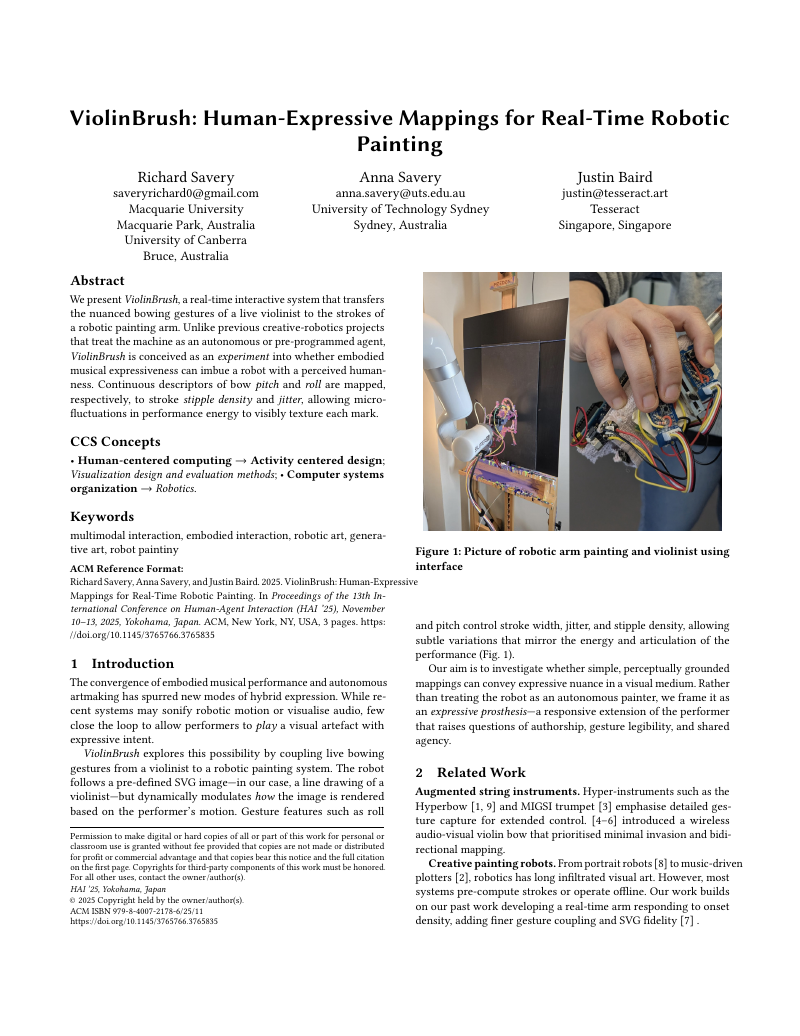
ViolinBrush: Human-Expressive Mappings for Real-Time Robotic Painting
Richard Savery, Anna Savery, Justin Baird
We present ViolinBrush, a real-time interactive system that transfers the nuanced bowing gestures of a live violinist to the strokes of a robotic painting arm. Unlike previous creative-robotics projects that treat the machine as an autonomous or pre-programmed agent, ViolinBrush is conceived as an experiment into whether embodied musical expressiveness can imbue a robot with a perceived humanness. Continuous descriptors of bow pitch and roll are mapped, respectively, to stroke stipple density and jitter, allowing micro-fluctuations in performance energy to visibly texture each mark, so that subtle variations mirror the energy and articulation of the performance.
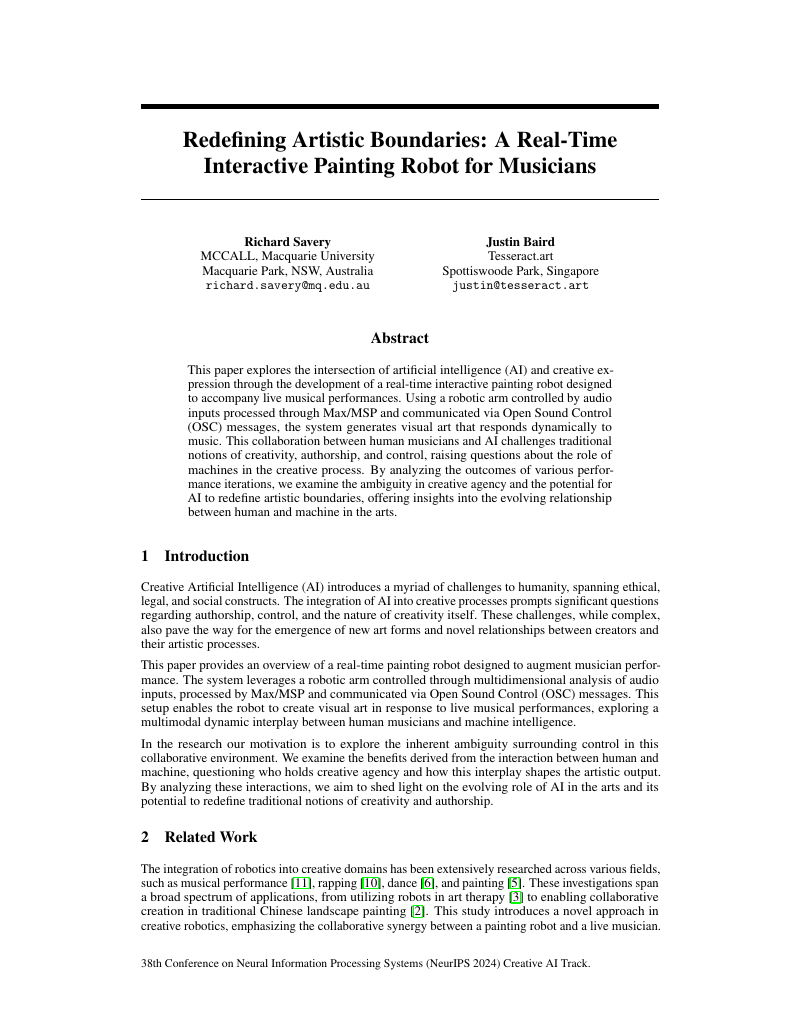
Redefining Artistic Boundaries: A Real-Time Interactive Painting Robot for Musicians
Richard Savery, Justin Baird
This paper explores the intersection of artificial intelligence (AI) and creative expression through the development of a real-time interactive painting robot designed to accompany live musical performances. Using a robotic arm controlled by audio inputs processed through Max/MSP and communicated via Open Sound Control (OSC) messages, the system generates visual art that responds dynamically to music. This collaboration between human musicians and AI challenges traditional notions of creativity, authorship, and control, raising questions about the role of machines in the creative process. By analyzing the outcomes of various performance iterations, we examine the ambiguity in creative agency and the potential for AI to redefine artistic boundaries, offering insights into the evolving relationship between human and machine in the arts.
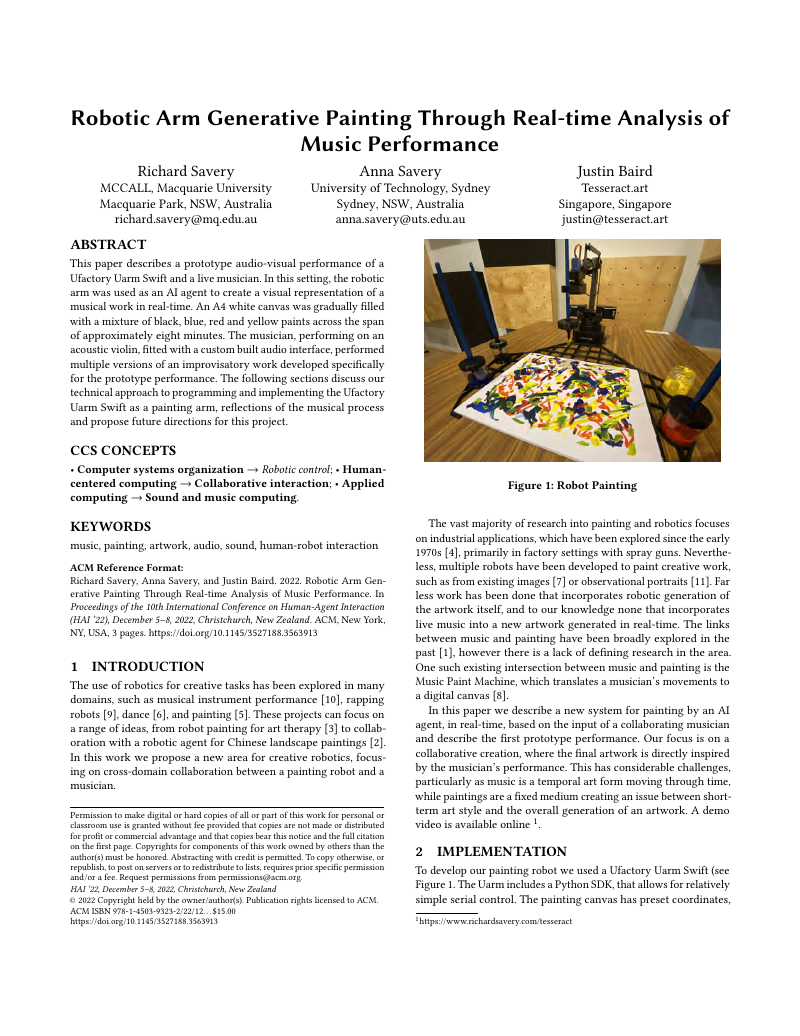
Robotic Arm Generative Painting Through Real-time Analysis of Music Performance
Richard Savery, Anna Savery, Justin Baird
This paper describes a prototype audio-visual performance of a Ufactory Uarm Swift and a live musician. In this setting, the robotic arm was used as an AI agent to create a visual representation of a musical work in real-time. An A4 white canvas was gradually filled with a mixture of black, blue, red and yellow paints across the span of approximately eight minutes. The musician, performing on an acoustic violin, fitted with a custom built audio interface, performed multiple versions of an improvisatory work developed specifically for the prototype performance. The following sections discuss our technical approach to programming and implementing the Ufactory Uarm Swift as a painting arm, reflections of the musical process, and propose future directions for this project.
Parametric Control of Filter Slope Versus Time Delay for Linear Phase Crossovers
David McGrath, Justin Baird, Bruce Jackson
Linear phase crossover filters are a powerful tool for sound system designers. They deliver a near-ideal response with ruler-flat pass-band, steep transition slopes and adjustable stop-band rejection, all with zero phase shift. Transition slopes can be matched to a target response, for example 24 dB or 48 dB per octave, and can also be arbitrarily specified while still retaining a perfect-reconstruction characteristic. Practical application of linear phase crossovers requires manipulation of cutoff frequency, transition slope and stopband rejection. A graphical user interface is described which gives users new degrees of freedom in defining linear phase filter parameters. This paper presents new parameters for optimization of a target transition slope within a bounded delay parameter, providing fast and efficient user controls for working with and adjusting the crossover filters in real time.
Raised Cosine Equalization Utilizing Log Scale Filter Synthesis
David McGrath, Justin Baird, Bruce Jackson
An improved method of audio equalization utilizing Raised Cosine Filters is introduced. Raised Cosine Filters offer improved selectivity in comparison to traditionally implemented equalization functions, while also maintaining beneficial attributes such as a minimum phase response. The Raised Cosine Filter also enables flat summation and asymmetrical filtering characteristics, resulting in an equalization system offering capability beyond traditional filter implementations.
Practical Application of Linear Phase Crossovers with Transition Bands Approaching a Brick Wall Response for Optimal Loudspeaker Frequency, Impulse and Polar Response
Justin Baird, David McGrath
Conventional crossover design methods utilize traditional frequency selective networks to combine multiple transducers into a single full-bandwidth system. These traditional networks, whether they are implemented in analogue or digital form, exhibit large transition bands and suffer from phase distortion. These characteristics result in poor frequency, impulse and polar responses. A practical crossover implementation is presented that removes the detrimental effects of transition bands and phase distortion. This method implements linear phase crossovers whose transition bands approach a theoretical ideal brick wall response. Comparisons to conventional crossovers are presented. Applications to large scale array optimization are also discussed and presented.
Far-Field Loudspeaker Interaction: Accuracy in Theory and Practice
Justin Baird, Perrin Meyer, John Meyer
The far-field model of loudspeaker interaction is a widely used technique to model the sound pressure radiated from arrays of loudspeakers. We provide a quick but thorough introduction to the mathematical foundation of the far-field model, and how the model compares, with regards to accuracy and computational efficiency, to other formulations such as series solutions and boundary element methods. We present data from a series solution of a model spherical loudspeaker, and compare this mathematical model to actual high-resolution measurements. Using this model loudspeaker, we discuss methods for calculating and measuring accurate loudspeaker far-field polar (or directivity) patterns, and we discuss how the accuracy of the far-field polar patterns affects the accuracy of the far-field model.
Accurate Electroacoustic Prediction Utilizing the Complex Frequency Response of Far-Field Polar Measurements
Wolfgang Ahnert, Justin Baird, Stefan Feistel, Perrin Meyer
Currently available electroacoustic prediction software represents far-field polar responses of loudspeakers by the magnitude of their directivity patterns. It is shown that the loudspeaker's phase response is necessary for increasing the accuracy of predictions at any frequency resolution. A method for accurately representing a loudspeaker's far-field magnitude and phase response for prediction purposes is presented.
The Analysis, Interaction, and Measurement of Loudspeaker Far-Field Polar Patterns
Justin Baird, Perrin Meyer
We present a mathematical framework for the analysis, interaction, and measurement of loudspeaker far-field polar patterns using spherically weighted acoustic point sources. We show it is not necessary to know the effective acoustical center in order to measure an accurate far-field polar pattern. We discuss a mathematical transform that makes this clear, and we show experimental evidence from careful measurements in an anechoic chamber.
Optimization Using Modified All-Pass Filters for Magnitude Compensation
Paul Kohut, Justin Baird
It is shown that modified all-pass filters can be utilized to further equalize a complex system by purposely introducing and characterizing error in pole-zero locations. In audio systems requiring magnitude and phase manipulation, filter order can be reduced using this approach. Design formulas are presented which describe these attributes in terms of classical filter parameters, functions, and formulas. Both analog and digital theory and applications are presented.